Click here or on the image below to view and download or print the fact sheet.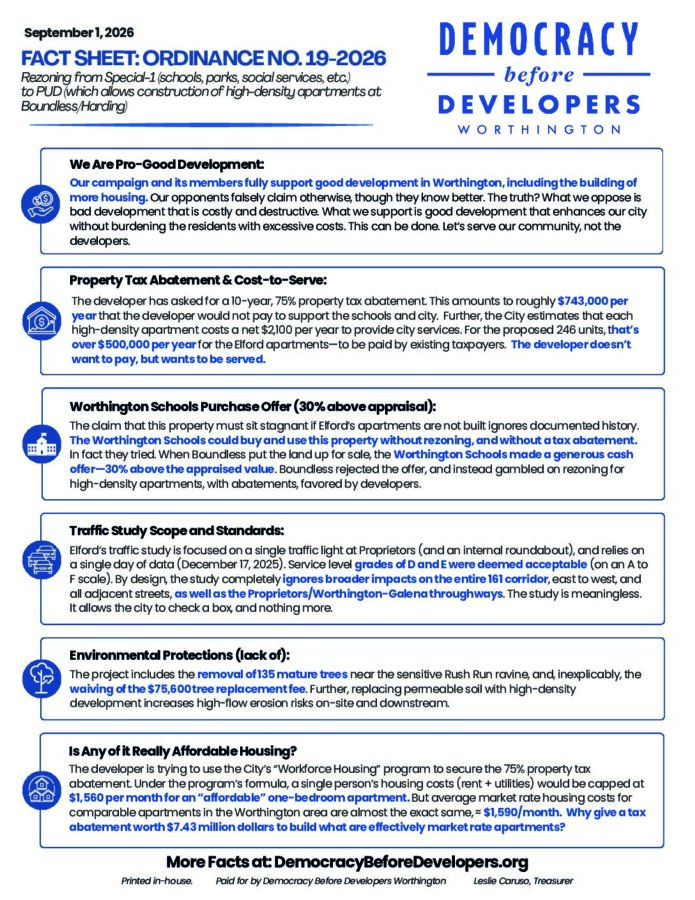
FROM THE FACT SHEET:
We are Pro- Good Development
Our campaign and its members fully support good development in Worthington, including the building of more housing. Our opponents falsely claim otherwise, though they know better. The truth? What we oppose is bad development that is costly and destructive. What we support is good development that enhances our city without burdening the residents with excessive costs. This can be done. Let’s serve our community, not the developers.
Property Tax Abatement & Cost to Serve
The developer has asked for a 10-year, 75% property tax abatement. This amounts to roughly $743,000 per year that the developer would not pay to support the schools and city. Further, the City estimates that each high-density apartment costs a net $2,100 per year to provide city services. For the proposed 246 units, that’s over $500,000 per year for the Elford apartments—to be paid by existing taxpayers. The developer doesn’t want to pay, but wants to be served.
What Worthington Schools has to say about tax abatements
Worthington Schools Purchase Offer (30% above appraisal)
The claim that this property must sit stagnant if Elford’s apartments are not built ignores documented history. The Worthington Schools could buy and use this property without rezoning, and without a tax abatement. In fact they tried. When Boundless put the land up for sale, the Worthington Schools made a generous cash offer—30% above the appraised value. Boundless rejected the offer, and instead gambled on rezoning for high-density apartments, with abatements, favored by developers.
Click here to read Worthington Schools' statement - scroll down to "Boundless Property."
Traffic Study Scope and Standards
Elford’s traffic study is focused on a single traffic light at Proprietors (and an internal roundabout), and relies on a single day of data (December 17, 2025). Service level grades of D and E were deemed acceptable (on an A to F scale). By design, the study completely ignores broader impacts on the entire 161 corridor, east to west, and all adjacent streets, as well as the Proprietors/Worthington-Galena throughways. The study is meaningless. It allows the city to check a box, and nothing more.
Worthington Pulse coverage of traffic study as discussed at 6/25 MPC meeting
Elford’s Traffic Study at Boundless: Inadequate Scope, Unacceptable Standards
Environmental Protections (lack of)
The project includes the removal of 135 mature trees near the sensitive Rush Run ravine, and, inexplicably, the waiving of the $75,600 tree replacement fee. Further, replacing permeable soil with high-density development increases high-flow erosion risks on-site and downstream.
More here:Environmental Impact vs. Downstream Safety.
Is any of it really Affordable Housing?
The developer is trying to use the City’s “Workforce Housing” program to secure the 75% property tax abatement. Under the program’s formula, a single person’s housing costs (rent + utilities) would be capped at $1,560 per month for an “affordable” one-bedroom apartment. But average market rate housing costs for comparable apartments in the Worthington area are almost the exact same, ≈ $1,590/month. Why give a tax abatement worth $7.43 million dollars to build what are effectively market rate apartments?
More here: Subsidizing a Low-Demand Housing Type
ALSO:
Density and Scale Transition
Placing 246 units onto 11.2 buildable acres creates an effective density of approximately 22 units per acre. This exceeds the city's maximum residential limit (14.5 units/acre) in the standard City Code (AR-3). Placing this density adjacent to a neighborhood of 4-5 units per acre conflicts with Codified Ordinance Section 1174.05, which mandates an "integrated and harmonious design" and an "appropriate transition in scale.”
Post-Vote Financial Disclosure
The City previously cited state of Ohio confidentiality laws to avoid the disclosure of official taxpayer cost estimates. This meant that the public had no firm information about the cost of the proposed Elford tax abatement prior to the vote at City Council to approve the rezoning for the project. Although the city administration eventually secured a confidentiality waiver from the developer to disclose these figures, they only did so after political pressure about the abatements increased. The result was that this information was released to the public only after City Council voted unanimously to approve the permanent zoning entitlements. If the City was able to obtain a waiver, why didn’t they do so before Council’s vote so the public would have been aware of this financial burden and addressed their elected officials accordingly? The result of the City indifference and inaction was a lack of public transparency that should have been prevented.
Per-Unit Taxpayer Subsidy
The developer proposes 74 units at 80% Area Median Income (AMI). Factoring in the value of the abatements, subsidizing these units equates to an estimated taxpayer cost of roughly $100,000 per unit. For context, the City's established "buyout" penalty for developers opting out of affordable housing requirements is $20,000 per unit. Taxpayers are being asked to subsidize this development at five times the City's established value.